Bespoke Sennheiser RF solutions used for Coldplay tour

Touring a mixture of arenas and stadiums in Europe and North America since 2011, Coldplay’s shows are performed on a main stage with a centre runway projecting out and ending in a second, smaller ‘B’ stage. In addition there is also a C stage at the back of the arena, right amongst the audience.
The entire band wears Sennheiser 2000 series IEMs and although in arenas all three stages are usually coverable from the main stage RF equipment, it hasn’t always been possible in stadiums.
“In stadiums, the ‘C’ stage is usually at the opposite end of the pitch to the main stage. This, along with location specific radio pollution, meant we needed to come up with a solution for local RF transmission for the band and crew’s IEMs on the C stage.” said the band’s RF engineer Ali Viles (pictured). “It was imperative that the radio coverage to all the stages was seamless, without any signal loss or dropout. We looked at several options, but all involved complex additional infrastructure and considerable expense.”
Sennheiser’s solution is based on the company’s Media Control Protocol, which enables the company’s rackmount devices to communicate directly with control units within an Ethernet network (UDP/IP). The units can then be remote-controlled and monitored directly from a central control panel, via an iPad, iPhone, or mixing console. Working with Viles, Sennheiser designed a standalone application using the Media Control Protocol, which allows simultaneous remote control of the RF mute facilities on multiple IEM transmitters.

“The software means that it’s possible to have a set of identical 2000 series IEM transmitters, on the same frequencies, located local to the stages at either end of the stadium and to swap which ones are transmitting at the touch of a button from a laptop,” said Viles. “As the band run through the audience between the two stages, it’s possible to switch the RF transmission between the two locations. This means that the band hears virtually seamless coverage as they move between the stages.”
In related news, Rik Simpson, Coldplay’s co-producer and recording/mixing engineer has recently purchased a pair of Unity Audio Rock MK II active monitors, which he used to mix the entire forthcoming Coldplay live DVD.
“They’ve saved my ears, it’s great that I can work at low levels for long periods and hear everything,” said Simpson. The clarity and depth of perception is something that I’ve never expected to find on such a small speaker like The Rock. The bass response is surprisingly deep, transient response snappy, and stereo depth impressively wide. I love them!”
www.sennheiser.co.ukwww.unityaudio.co.uk

Two new CL5 consoles have been installed as part of a major refurbishment of the Madrid studios, owned by production company 7 y Acción.
El Hormiguero is the company’s flagship production, attracting both nationally and internationally famous guests and broadcast on Antena 3 TV.
Madrid-based AV company Videoreport led the refurbishment, designing and installing the new system, including a Dante audio network.
The first phase of installation comprised two CL5 consoles, cascaded to provide a single control surface with 72 faders. Three Rio3224-D rackmount i/o units – two in the main studio and one in the control room – provide the system with 160 channels of simultaneous audio. Installation of a second phase of equipment is currently underway, which will see a Yamaha CL1 and another Rio3224-D installed.
„The sound control design took into account many factors,” said Rafael Chorro (pictured), Videoreport’s chief technician on the project. “7 y Acción’s increasing technical requirements meant that we needed bigger control surfaces and a system that could easily accommodate both analogue and digital input/output channels.
Since the new system was installed in August, El Hormiguero has proved that Yamaha CL series consoles can fulfill the most demanding broadcast applications. I believe the new consoles and Rio i/o units are giving the broadcast industry much to talk about.”
“Budapest exceeded our expectations as a distinctive site for our 2012 European convention,” stated AES executive director Bob Moses. “We attracted a number of eastern European audio professionals who had not previously had the opportunity to participate in an AES event. The feedback we received from them as well as from our traditional AES European Convention attendees was extremely positive.”
Both organisers and exhibitors highlight a particularly strong turnout for workshops and tutorials. David Josephson of Josephson Engineering commented: “The show was really worthwhile. We saw a lot of students and pro users. The technical sessions seemed stronger and better attended than the last London show. We went because it was the first time we could reach out to buyers in Eastern Europe. The opportunity for seeing significant people is absolutely worth attending an event like this.”
Moses also credits a new paper review process for playing a part in the quality of research papers, which he reports was particularly high at this Convention.
“The 132nd Convention clearly confirms the importance of continuing the AES European show. We are already in the planning stages for our next event, and will be incorporating changes our stakeholders are requesting to add value and ensure its long term success,” Moses concluded.
Despite the (unsurprising) upbeat spin from the AES, the European event (and previous European AES shows in general) have received criticism from certain quarters through forums on LinkedIn. PSNEurope has been promised an exclusive interview with Moses for a forthcoming edition, in print and online, where we shall be asking the ED how the AES can renew and rebuild its presence in Europe.
Some of the diverse, compelling, and educational workshop events will include:
Distributed Music Panel
Chair: Alex Case, Panel: Nathan Brock, Alvaro Barbose, David Willyard (remotely) and Karl Steinberg (remotely).
This workshop covers the emerging field of music intended for performance over networks, including both advanced research and the public Internet. Topics such as determined limits for delay between locations, and methods for performance above and below these thresholds will be addressed. Soundjack and the Jamlink hardware interface will be discussed as examples of realistic interaction over networks. There will also be a discussion of artistic strategies for overcoming excessive delay in performance.


Alex Case Jim Anderson
Reality Is Not a Recording/A Recording Is Not Reality
Presenter, Jim Anderson.
Former New York Times film critic, Vincent Canby, wrote „all of us have different thresholds at which we suspend disbelief, and then gladly follow fictions to conclusions that we find logical.” It is the responsibility of the recording engineer and producer to create a universe so compelling and transparent that the listener isn’t aware of any manipulation. How can we produce a listening experience that is both logical and better than reality? What techniques can be applied?

Audio Hardware in Smartphones
Chair: Antti Kelloniemi.
Comparisons between novel Smartphones and other professional or consumer audio equipment reveal that phones provide highly sophisticated audio functions for their size and price. Users expect high-quality noise reduction and echo cancellation, wide frequency response, and high dynamic range. Quality expectations keep rising, while devices must remain small and affordable. This workshop will provide introductory level Smartphone audio solutions and a discussion of current audio performance requirements. Examples of state-of-the-art audio component technology will be demonstrated.
For a complete list of event titles, abstracts and presentation times, visit http://www.aes.org/events/132/calendar/calendar.cfm
Audio Engineering Society
www.aes.org
Expands professional LCD studio/field line-up of products

Panasonic has launched a new HD/SD monitor, the BT-LH1850. The 18.5″ unit provides 1366 x 768 resolution and is being marketed by the company as offering improved cost-performance and significant advances in functionality.
„The WXGA-resolution LH1850 delivers the professional features and outstanding price-to-performance users have come to expect from a Panasonic LH-Series monitor,” noted Steven Cooperman, product manager, Panasonic Systems Communications Company of North America, in a statement.
„And now we’ve added
additional versatility
 withthe ability to view any camera source with
an HD/SD SDI or HDMI output, and it displays HD
and SD closed captioning, too.”
Besides HD/SD SDI and HDMI connectivity, the new monitor offers a wide variety of features, including a 3D look-up table (LUT) for improved color correction and monitoring, HD and SD closed caption display, waveform monitor for R/G/B signals, vectorscope, an RS-485 serial remote, and an mercury-free LED backlight
that provides reduces power
consumption. ( – )
Source: http://www.broadcastingcable.com

Blackmagic Design last week in Manchester UK . announced that production house Brightonart Ltd built a comprehensive AV control solution around Blackmagic Design’s ATEM 1 M/E Production Switcher to capture runway looks from Vauxhall Fashion Scout, the largest independent showcase of the Fall 2012 London Fashion Week. Internationally recognized as a driving force behind innovation in fashion, Vauxhall Fashion Scout actively promotes both new and seasoned designers to an international audience through catwalk shows, presentations, fashion films and exhibitions. Based during London Fashion Week at the Freemasons’ Hall in central London, Fashion Scout looked to Brightonart to produce the catwalk videos that would be uploaded to Vimeo.


Brightonart used Blackmagic Design’s ATEM 1 M/E Production Switcher to cut live footage from HD-SDI video feeds shot by two Sony EX-1 cameras. Program output was then captured on two SSD recorders; a Blackmagic Design HyperDeck Studio recording uncompressed 10-bit as a rolling backup and the other using DNxHD or ProRes as the master working file. Signal distribution was handled by Blackmagic’s Multibridge Pro, which took care of the audio embed. The ATEM 1 M/E was also used for static or animated graphic loops that the designers wanted projected on the back wall of the runway, which were run out of an auxiliary port on the switcher and managed on a PC using Resolume Avenue VJ Software.
“Because we did the live cut out of the ATEM 1 M/E down to our SSD recorders, those files went straight into Sony Vegas in ProRes,” said Mark Scarratt of Brightonart Ltd. ”We then performed an audio check, and mixed if necessary, before finally adding in the applause from the ambient microphone. Next, we inserted title and end graphics before crunching the footage down to H.264 to be uploaded to the web.”

For remote work away from the main catwalk within Freemasons‘ Hall, Brightonart used Blackmagic Design’s ATEM Television Studio, which filled the need for a compact and portable AV solution in the secondary control room. Scarratt explained, “We didn’t have the space to mirror our main set up in the second smaller hall, but the flexibility of this compact solution enabled us to provide high quality HD-SDI video at very short notice to the streaming partners brought in for additional shows, greatly surpassing their expectations.”
“Over the six days of Fashion Week, we’ve shot and cut more than 30 catwalk shows. Thanks to the Blackmagic 1080/50i workflow, only minimal post production of the footage was required, ensuring that every show was online in HD within two hours of its completion.”

About ATEM Production Switchers
Empower live creativity with the new ATEM Production Switchers! For the first time extremely powerful broadcast grade features, incredibly small size and low cost have been designed in a live production switcher! ATEM Production Switchers include 4 upstream keyers each with independent chroma, shaped and linear keying, 2 downstream keyers, stinger effects, graphic wipes, media players for stills and clips and a built in DVE for amazing DVE transitions or key repositioning. For portable use, the built in Multi View showing all cameras, preview and program can be viewed on a single SDI or HDMI monitor.
ATEM also includes loads of HDMI and SDI inputs allowing professional SDI cameras as well as consumer HDMI cameras and computers to be connected. Only ATEM allows low cost HDMI consumer cameras in a professional switcher so it’s easy for customers starting out in live production! ATEM includes a free software control panel and media pool management software for Mac OS X and Windows 7. ATEM is sold independently of the hardware control panel allowing lower initial cost and greater customization. ATEM retails for only £1,625.
About Blackmagic Design
Blackmagic Design creates the world’s highest quality video editing products, color correctors, video converters, video monitoring, routers, live production switchers, disk recorders, waveform monitors and film restoration software for the feature film, post production and television broadcast industries. Blackmagic Design’s DeckLink capture cards launched a revolution in quality and affordability, while the company’s Emmy™ award winning DaVinci color correction products have dominated the television and film industry since 1984. Blackmagic Design continues ground breaking innovations including stereoscopic 3D and 4K workflows. Founded by world leading post production editors and engineers, Blackmagic Design has offices in the USA, United Kingdom, Japan, Singapore, and Australia.
For more information, please check www.blackmagic-design.com
Fremont, USA – February 17, 2012
HyperDeck 2.5 public beta for Mac OS X and Windows is available for download now and is free of charge for all Blackmagic Design customers. This update includes support for both HyperDeck Shuttle 2 and HyperDeck Studio models of Blackmagic Design SSD recorders.
HyperDeck 2.5 software includes timecode support for both HyperDeck Shuttle and HyperDeck Studio. Timecode information embedded within the ancillary data space of HD-SDI video signals can now be written to HyperDeck’s uncompressed or Avid DNxHD compressed video files. Customers can preserve the timecode from their incoming video stream based on the standard RP-188 HD protocol and playback recorded files with this original timecode information.
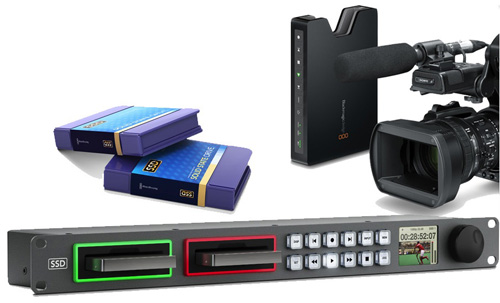
HyperDeck Shuttle and HyperDeck Studio models feature Avid DNxHD record and playback that is fully certified by Avid. HyperDeck 2.5 software adds the option to record and playback DNxHD QuickTime as well as DNxHD MXF format files. The choice to wrap DNxHD files in a QuickTime format extends the opportunity to use Avid’s industry standard file encoding with a wide range of software and to suit specific workflows.
Recording to HyperDeck Shuttle can now be automatically triggered by cameras and other HD-SDI video equipment. Many professional cameras embed start/stop flags within their SDI video output and HyperDeck Shuttle now recognizes these commands to start and stop recording in sync with the camera. The advantage is that customers can now record to HyperDeck Shuttle without the need to separately activate recording on their camera and disk recorder.
As some cameras don’t output the start/stop flag in the standard way, this new update also includes a new rolling timecode record trigger feature. This means now virtually any camera or device that outputs RP-188 timecode can be used to start and stop HyperDeck Shuttle recording! HyperDeck will now watch RP-188 HD timecode and when the time code starts counting, the HyperDeck will instantly start recording! This means even professional equipment and cameras like the ARRI ALEXA can now automatically trigger HyperDeck Shuttle to record uncompressed or DNxHD timecode synchronized files!
“This software update adds a number of valuable functions to HyperDeck,” said Grant Petty, CEO, Blackmagic Design. “We’ve based this on feedback from HyperDeck customers on the features they needed most and this feedback reflects the wide use of HyperDeck recorders from acquisition through to content delivery.”
Availability and Price
HyperDeck 2.5 public beta for Mac OS X and Windows is available for download now and is free of charge for all Blackmagic Design customers. ( – )
About Blackmagic Design
Blackmagic Design creates the world’s highest quality video editing products, color correctors, video converters, video monitoring, routers, live production switchers, disk recorders, waveform monitors and film restoration software for the feature film, post-production and television broadcast industries. Blackmagic Design’s DeckLink capture cards launched a revolution in quality and affordability, while the company’s Emmy™ award winning DaVinci color correction products have dominated the television and film industry since 1984. Blackmagic Design continues ground breaking innovations including stereoscopic 3D and 4K workflows. Founded by world leading post production editors and engineers, Blackmagic Design has offices in the USA, United Kingdom, Japan, Singapore, and Australia. For more information, please check
www.blackmagic-design.com
Shotoku Sales Director James Eddershaw made the announcement from the company’s European headquarters in Staines, UK.
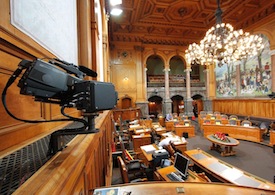
The project entailed complete replacement of outdated technology in the Ständerat chamber with Shotoku’s state-of-the-art Orchestra Camera Management System (CMS) with a TR-16S Shot Control Panel to direct seven strategically mounted TG-27 robotic pan/tilt heads. The Shotoku management system is fully integrated with the facility’s vision mixer and audio controls.
„We have been working with Shotoku for several years and had no hesitation completing the final stage of the TV upgrade [with] Shotoku’s TG-27 head and Orchestra control systems,” said Technical Project Manager Hermann Krähenbühl. „We operate with a combination of microphone-driven automatic control and operator-driven, joystick control for smooth on-air close-up work Shotoku’s Orchestra CMS system provides the perfect solution for this careful balance of requirements.”
„Shotoku provided systems for the Nationalrat [National Council] Chamber and Press Centre in recent years and we are delighted now to complete this major upgrade for the Ständerat,” said Eddershaw. „Our parliamentary TV system—based on the TG-27 head, TR-S shot panel and Orchestra CMS software—is built on years of experience gained from operations in parliaments across the world. As a result, it is very well suited to the uniquely demanding application of live coverage of extended debates in large chambers.”
TVBEurope
The broadcaster is launching Sky Sports F1 HD with the first race in Melbourne, March 18. Gearhouse Broadcast has built a series of interconnecting flyaway pods weighing 17-tonnes to Sky criteria.
“Everything from Sky Sports F1 news to packages and promos will be produced in HD and with 5.1 audio,” said Darren Long, director of operations, Sky Sports . “F1 is not just about the pictures but the equally amazing sound such as the individual sounds of each car or the sound of the race when switching between feeds.”
SIS Live built the HD system in use by the BBC for its F1 coverage. “We chose Gearhouse because of its expertise in World Cups and flying equipment around the world,” said Long.
Sky is also taking a different approach to storage and workflow. Omneon MediaGrid shared storage systems will be housed at Sky Studios and in the flyaway pods and hooked into Avid ISIS for media management. Final tests are being conducted at Sky and Gearhouse.
“Traditionally we might have used Avid ISIS for the whole package. MediaGrid is cost effective, it is a powerful system and it’s a good way of getting content to the edit. We are looking at MXFServer (developed by FilmPartners) to also allow us to use the storage in an even more efficient manner on the road and at Sky HQ.”
The MXFserver project and media management system supports Avid Media Composer, Final Cut Pro, Adobe Premiere, and other edit applications. It allows editors to use different platforms, share content in a single storage pool, and work privately or collaboratively on projects.
“We’ve really focused on the quality of equipment, its modularity and the editing workflow,” he added. “We’ve an incredibly large matrix tying everything together in HD and 5.1.”
P2 cameras will be deployed with radio links provided by Wisycom, which, “is good at adapting between frequencies and between countries with different frequencies so we don’t have to swap various kit out each time we relocate,” said Long.
All seven feeds, allowing viewers to choose between main race, onboard cameras or stats for example, will be sent back to Sky on a fibre optic network jointly delivered by the EBU and AT&T.
“We don’t want to rely on satellite so we are sending and receiving feeds via fibre,” said Long. “At&T are already onsite delivering data for teams and it has an extensive worldwide network.”
Sky will air Formula One races for the first time in a deal starting March until 2018 (with half the races also broadcast on the BBC). Sky will TX all the races, qualifying and practice sessions.
None of Sky’s F1 production will be in 3D but Long is not ruling it out in future. “We will always try and develop alongside FOM (the F1 host broadcaster) and we will grab that opportunity if and when it comes.”
Sky will provide coverage through its mobile app Sky Go, on its website and is also promising innovative second screen applications.
TVBEurope
Desktop Video 9.2 beta 1 for Mac OS X is available for download now and is free of charge for all Blackmagic Design customers. This update includes support for all current DeckLink, Multibridge, Intensity and UltraStudio models.

DeckLink
Broadcast monitoring in Final Cut Pro 10.0.3 allows video output to external monitors and other equipment using the SDI, HDMI or analog video outputs from Blackmagic Design video hardware.
Desktop Video 9.2 beta 1 includes a new control panel for selecting the video output format from Final Cut Pro X for output to devices such as broadcast quality monitors, HDTVs and projectors, so you can see exactly what your master will look like in television colorspace.

Multibridge
Desktop Video 9.2 beta 1 also includes Media Express 3.1 beta. Media Express provides capture, logging and management of video files to Final Cut Pro X compatible formats including ProRes and uncompressed video. Media Express features timecode accurate video capture from professional VTRs with RS-422 control, the ability to log additional metadata and to create custom bins for managing all project video media.
Final Cut Pro X 10.0.3 includes XML 1.1 for exporting primary color grades to DaVinci Resolve. This improved XML support makes it easier to move projects from FCP X to Resolve as any primary color changes carried out during editing can now be imported and applied automatically within Resolve. Once a project has been color graded with DaVinci Resolve it can be reopened simply within Final Cut Pro X for any further editing.

Intensity
“We are extremely pleased to provide immediate support for the new monitoring feature in Final Cut Pro X 10.0.3,” said Grant Petty, CEO of Blackmagic Design. “Now working with Final Cut Pro X is even better since our customers can accurately view projects on whatever monitor they choose and can ensure that their final output meets crucial broadcast standards.”

Ultrastudio
Availability and Price
Desktop Video 9.2 beta 1 for Mac OS X is available now free of charge from the Blackmagic Design support page at www.blackmagic-design.com/support.
The studio is being implemented by Somos Broadcast Media, a systems integrator and reseller serving the Hungarian broadcast market.

“With this Mosart installation, TV2 is the first broadcaster in Hungary to adopt modern studio automation,” said Rozgonyi Laszló, technical director at Somos Broadcast Media, the reseller integrating the technology.
“Although TV2 had originally chosen another studio automation system, all it took was one presentation from Mosart to convince the network’s engineers that they could take their newscast automation to a much more advanced level.”
TV2 Hungary went live with Mosart® in January 2012, in conjunction with the launch of the new facility. One large selling point for TV2 was the solution’s ability to integrate with almost all studio devices, without requiring the network to be tied to any manufacturer’s hardware. Mosart now supports four manufacturers of vision mixers, eight audio mixers, eight brands of servers, eight graphics systems, and five camera robotics systems.
“With Mosart we’re able to produce news and features with fewer people in the control room and streamline our production processes — resulting in a better-quality newscast with fewer human errors,” said Laszlo Szilagyi, head of TV2’s technical department. “The system’s advanced handling of macros, sequences, loops, and continue points greatly simplifies automation setup, enabling our news director to program once and then proceed through multiple events and effects.”

Content repurposing/reuse is enhanced with Mosart’s delivery of news as-run information to Web publishing platforms, continuity control, or media asset management (MAM) systems. Mosart’s customizable graphical interface makes it easy for story elements such as cameras, clips, and graphics to be assigned to on-screen buttons for easy and quick access. A range of interface overviews can also be assigned to buttons, making the GUI a virtual shot box for touchscreens, and easily adaptable for a range of TV productions. Story scripts from the newsroom computer system are shown directly in the Mosart GUI, and Mosart operators can store clips and graphical elements in a pool ready for execution on request.
“It is a strong reinforcement of Mosart Medialab’s European market leadership and innovative excellence that TV2 Hungary, a highly respected national broadcaster, has chosen our solution to drive its news operations,” said John Kjellevold, managing director at Mosart Medialab.
Giodano, along with Dalet Director of Marketing Raoul Cospen, will tell the audience how new technology has impacted on the Mediaset organisation and on the way content is produced. The case study will examine how sports highlights creation, sports magazines and the newsroom connect together.
The case study, to be presented at TVBEurope’s conference in the Soho Hotel, London, will explain how the centralised architecture of the system can be designed to achieve multi-site production.
Beyond the production tools, Giodano will reveal what business benefits you can expect from MAM-driven workflows in your newsroom. Learn also about new distribution methods and innovations in the press sector, and possibilities for future developments in this area.
www.fastturnaroundtv.com
TVBEurope
The BBC will use Mobile Viewpoint’s Wireless Multiplex Terminal (WMT) to broadcast the relay live on the Internet and BBC channels.
The vehicle in front of the relay, responsible for the live coverage, will use the WMT to transmit the images using a combination of different mobile 3G networks. The WMT uses four to eight SIM cards of different operators to create a stable video connection. Mobile Viewpoint, in cooperation with the BBC, developed Continuous Picture Technology (CPT) to ensure a smooth video link when driving through the rough countryside with varying mobile coverage conditions.
“Every customer and project proves that our technology and products can play an important role in creating new formats,” said Michel Bais, managing director Mobile Viewpoint. “With the WMT it is possible to have live video connections from any place and any location as long as there is coverage of a mobile network. The Olympic Torch Relay project is a unique example, because it shows the possibility to realise a live video connection even if there are difficult network coverage circumstances. We are proud about the partnership resulting in the development of the unique CPT technology. This project shows again that Mobile Viewpoint’s WMT technology provides an alternative for satellite connections and will lead to the development of new (reality) TV formats following people in their day to day life.”
www.mobileviewpoint.nl
TVBEurope
Broadcaster NEP Supershooters’ trucks will feature Grass Valley HD production gear, including cameras, video production switchers, routers and signal conversion modules.
Jeff Rosica, executive vice president of Grass Valley, said: “Live sports production is a main focus of our company and we’ve supported high-profile productions like the Super Bowl for many years, because quality and reliability matters most.”
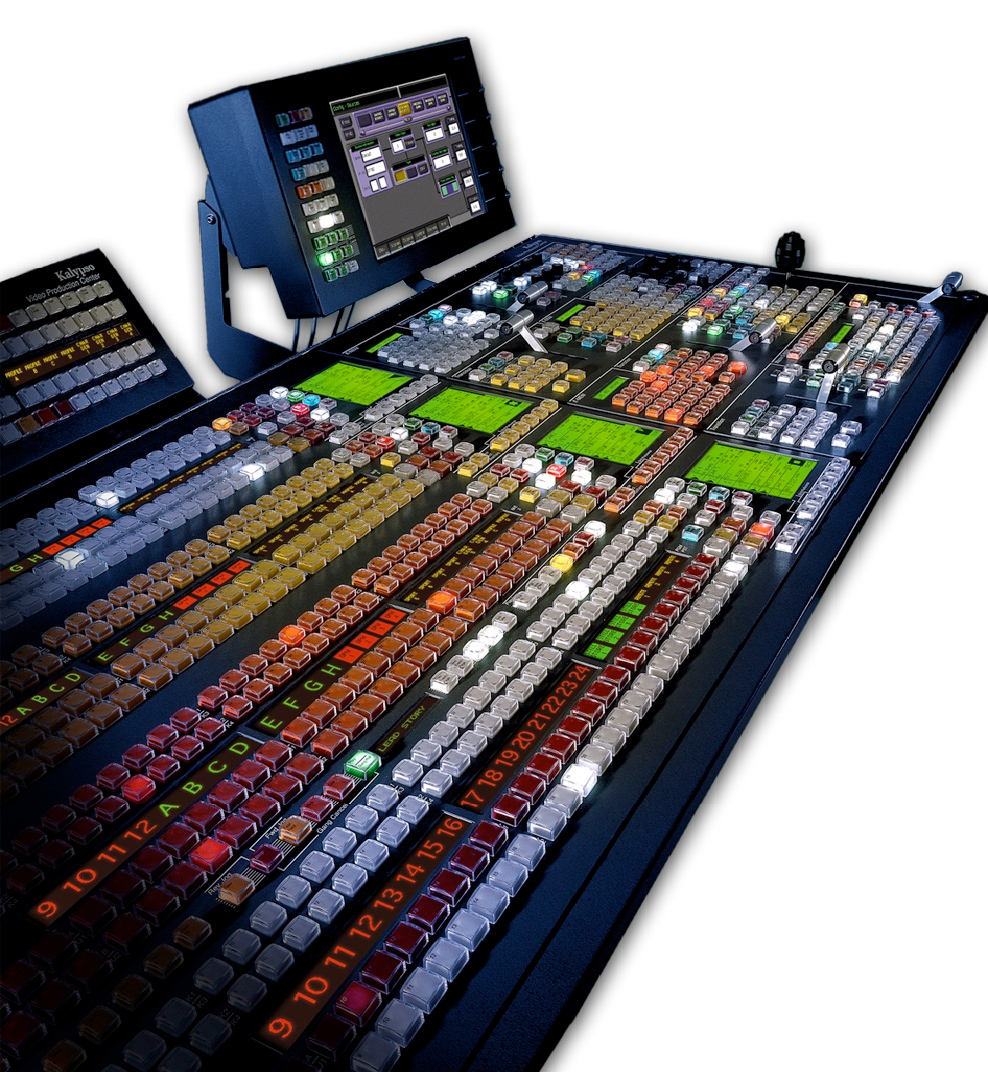
NEP’s SS24 HD mobile production truck features a Grass Valley Kalypso Video Production Center switcher (pictured), as well as Trinix NXT and Concerto Series routing switchers. The company’s SS25 truck carries a Grass Valley Kalypso Video Production Center switcher, more than 12 Grass Valley LDK 8000 Elite WorldCam HD cameras, as well as Grass Valley Trinix and Concerto Series routers. The ND4, California, and Summit vehicles all include a Grass Valley Kalypso Video Production Center switcher on board.
“With the entire world watching, it’s critical that our productions look the best they can,” said George Hoover, chief technology officer at NEP. “For our money, that means using Grass Valley equipment where it’s appropriate. We are a long-time fan of their production switchers and cameras and continue to use them whenever our clients need uncompromising quality and flexibility.”
TVBEurope
In a wide-ranging interview with Digizone, its CEO Janka Vozarova and programme director Janis Sidovsky also said that it attained a 7% share of Czech TV ad revenue last year, with sales, including advertising, amounting to over CZK300 million (€11.8 million).

They added that TV Barrandov, which was launched three years ago this month, is also approaching breakeven.
Its future plans include the launch of an on demand service this autumn.
source: http://www.broadbandtvnews.com/2012/01/24/tv-barrandov-denies-ringier-rumours/
According to Trud, this follows last week’s rejection of DTVB’s appeal to the Bulgarian Supreme Court (SAC) over the award of the public service multiplex to the Latvian company Hannu Pro even though the prosecutor argued that the competition organised by the Commission for Communications Regulation (CRC) was flawed.
The SAC’s decision can only be appealed to the EC, which is itself preparing to take legal action against Bulgaria over the licence awards, which were made to Slovakia’s Towercom (two multiplexes) and Hannu Pro (four multiplexes) in 2009.
DVBT argues that a seventh multiplex, which Bulgaria has now said it will launch, would be at a disadvantage as it would make its debut after the first six.
source: http://www.broadbandtvnews.com/2012/01/24/bulgarian-dtt-dispute-escalates/
DaVinci Resolve for Windows public beta is available in both the full featured DaVinci Resolve 8.2 and free DaVinci Resolve Lite versions. The DaVinci Resolve 8.2 for Windows license is included with the Mac OS X version, so all current Mac OS X customers automatically get a license for the Windows version, and can download it now to use in their facility.

This new DaVinci Resolve for Windows beta will allow customers to use a wide range of hardware for building color correction systems with the advantage of a wider selection of GPU processing options with support for up to 4 GPU’s per system.
When the public beta program is complete, and DaVinci Resolve for Microsoft Windows™ is formally released, it will be accompanied by the Mac OS X version. When a customer purchases DaVinci Resolve, they can choose which operating system they want to use, and then install either one. This allows the flexibility to let customers potentially choose to use a Windows desktop computer in the office with powerful multiple GPU processing, while at any time the customer can unplug the dongle and plug into one of the latest stylish Mac OS X MacBook Pro computers when on set.
Only DaVinci Resolve lets customers move between either operating system at any time without the extra expense of purchasing a second copy of the software.
As a reward for all current DaVinci Resolve customers, any customer who has purchased the Mac OS X version of DaVinci Resolve can now keep using the same dongle for the Windows version of DaVinci Resolve, and they can simply download the Windows version. This will ensure current DaVinci Resolve customers are kept up to date with the latest features, and are not disadvantaged for purchasing early.
DaVinci Resolve will now be available in three models. DaVinci Resolve Lite, the current free version, is now available in both Windows and Mac OS X downloads. DaVinci Resolve Software for US$995 is now available for both Mac OS X and Windows and customers will get support for both operating systems for the one purchase. DaVinci Resolve with the full colorist designed control surface will be available with Mac OS X, Windows and Linux software, allowing the customer to choose any of three operating systems to build their color correction system.
“This Windows release has happened way sooner than we expected, and the DaVinci engineering team have done an amazing job!” said Grant Petty, CEO, Blackmagic Design. “We think this is very exciting because it makes DaVinci Resolve more flexible for customers, and makes it even easier to integrate Resolve color correction into any facility workflow even when using a wider range of editing and effects software.”
Availability and Price
DaVinci Resolve for Microsoft Windows 7™ public beta is now available for download from the Blackmagic Design web site free of charge for all current DaVinci Resolve customers. When released, DaVinci Resolve 8.2 for Windows will be included with the Mac OS X version for US$995. DaVinci Resolve Lite will be available for both Mac OS X and Windows 7, free of charge.

It would have been a shock if the organisers of the London 2012 Olympic Games had not included stereo 3D in their plans so it was no great surprise when the official announcement of its inclusion came.
Back in 2008, around the time of the Beijing Games, live 3D broadcasting was an experiment. In March of that year when the BBC trialled the world’s first live 3D HD transmission to select cinemas of a Calcutta Cup rugby match, the mission was considered a success that the feed reached the cinema at all.
By 2010 with the multi-camera, 25-match production of the FIFA World Cup, a technical workflow had been established and this year, at the US Open and Wimbledon, it had developed into a fully integrated outside broadcast. The technology is proven, and while there will continue to be technological developments, the focus has turned to refining production values.
However, while the IOC and its broadcasting subdivision the Olympic Broadcast Services (OBS) could be confident of delivering a technically proficient and polished 3D product for 2012 they still need to ensure that the time and effort was worthwhile.
That it intends to produce 300 hours of 3D (from a total of 5000 hours total games coverage) is perhaps the main surprise. At that volume 3D can no longer be considered an experiment or just for archive as seemed the most likely scenario even six months back. The IOC has clearly received strong messages from its major rights holders including NBC, the BBC and ESPN in support of a sizeable commitment to 3D production.
“The only reason we have decided to produce in 3D is to satisfy the demands of our rights holders,” Manolo Romero (pictured), chief executive of Olympic Broadcast Services (OBS) tells TVBEurope. “We would not be producing in 3D were it not for them.”
Although he declined to name which broadcasters have requested 3D, Romero said that there were currently 15 on board, a figure he expected to grow considerably, including some “very major ones”.
Events at 14 venues (of the 32) will be used for coverage, enough for OBS to create a 10-hour daily mix of 3D live and highlights. This will be produced separately from the main 2D broadcast by three outside broadcast crews. It will also be distributed with English commentary.
Each mobile unit will carry 12-14 rigs for around 40 camera positions. Fifteen to 20 ENG crews sporting Panasonic integrated 3D camcorders (including its new prosumer model HDC-Z10000 and the AG-3DP1) will also contribute as well as being used “to get near to the athletes in some sports,” Romero says.
“We will cover the opening and closing ceremonies, and major Olympic areas of gymnastics, track and field, swimming and the Olympic park,” he adds. “We will also experiment with other sports dependent on the demand for them from rights holders. Some of the sports have not been captured in 3D before.”
These include swimming and canoeing. The potential of canoeing with oars and boats slaloming round posts in splashing water is obvious though swimming could be trickier given that much of the athlete’s action happens underwater. Presumably OBS would have to position the 3D cameras as close to the water level as possible, or optimise the underwater tracking camera system.
“One of the challenges is to locate 3D camera positions in places where there are currently optimum seating positions,” says Romero. “We will find a way. We need to try to do our best to make it look good, but it will not be easy. We will follow our philosophy as with other technology which is to push the technology, to try our best and when we reach a limit which we cannot overcome we hope that for the next games we will do better.”
Winning the prize
Rights holders will be able to receive the live feed or ENG-ingested footage at the IBC to compile their own 3D broadcasts, but OBS will also create a live and highlights package of one hour, daily. “This is for those broadcasters who do not have a 24-hour dedicated 3D channel, but who can perhaps segment short 3D broadcasts on their existing channels,” says Romero. This would include the BBC, which aired its first live 3D coverage earlier this year on BBC HD of the Wimbledon tennis finals.
OBS will be contracting a 3D production specialist, but this has yet to be awarded and will be arguably the most prestigious and certainly largest 3D live event project to date.
There aren’t too many production teams with the appropriate expertise to choose from. Sony was the driving force behind the FIFA World Cup 2010 3D and Wimbledon in 3D, partnering with CAN Communicate and using Element Technica rigs on both occasions – though CAN would consider themselves technology-agnostic.
3ality Technica, which now owns Element Technica, has huge experience as a technology partner to Sky Sports in tandem with OB crews from Telegenic and others and can’t be dismissed.
The Cameron-Pace Group (CPG) has conducted 140 live events, mostly sports, including the recent X Games for ESPN. Its business model requires the client to sign up to CPG technology and production services. Another option would be to task the Belgian firm Alfacam, which is supplying a third of the 60+ OB facilities for London 2012, to organise specialist teams.
Since Alfacam is also majority equipped with Grass Valley gear, the recent CPG Grass Valley technology alliance lends weight to the idea that Cameron and Pace are front-runners.
Vince Pace, co-chairman of CPG, revealed to TVBEurope that he is in discussions about a 40-45 3D camera event which would be about the size of the Olympics job. Pace says: “We shot with 14 cameras on the US Open and we shot 19 cameras for the X Games. We are talking about a production today that will carry 40-45 cameras.
“The chief question is, what does it cost to do World Cup soccer or the Olympics in 3D and we are probably the leading company providing a cost model that can compete with 2D.”
Cameron adds: “It would be fantastic to do the Olympics. I don’t think there is anybody around who could do it better in terms of integrating 3D cameras into robocams and unique POV situations.”
In fact, the Olympic 3D contract is in the gift of sponsor Panasonic, which is between a rock and hard place deciding whether to grant the oxygen of Olympics publicity to two of its chief rivals whose kit will surely be heavily involved (Sony or GV).
As for Romero, he is equally, if not more, excited by the innovation of multi-channel distribution for next year which he says will help create the biggest ever audience for an Olympics yet.
“We did this for the first time for Vancouver but this is on an entirely different scale,” says Romero. “We are providing 12 channels by satellite of Olympics coverage in English, Arabic and Spanish language commentary as well as a complementary data feed which will enable any broadcaster which may not have the resources to come to London to organise a substantial Olympics operation.
“In some cases broadcasters do not have the bandwidth to be able to bring all the signals back to their domestic audience on their own. They can use it as a main source or as secondary source or simply as a source for additional shots. I believe this is going to be a revolution on its own.”
Broadcasters in New Zealand, Asia, Korea and the US, among others, will benefit, which will help boost the already massive global audience for the event. “I have no doubt this will bring the biggest Olympic Games audience ever. Hands down. That is one of our goals,” says Romero.
Blackmagic Design today announced DaVinci Resolve 8.1, an exciting new software update with powerful features, is now available. This update is available to all DaVinci Resolve customers free of charge and can be downloaded from the Blackmagic Design web site.
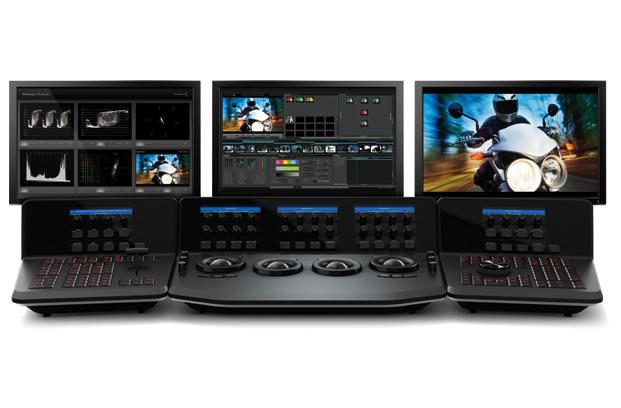
The new Resolve 8.1 software update includes support for Apple Final Cut Pro X XML round trip, new layer node composite effects, ACES colorspace support, compatibility with Avid AAF for round trip with Avid Media Composer™, Final Cut Pro 7 clip size and position support, new copy commands for grades, upgraded EDL features, support for UltraStudio 3D for Thunderbolt™ and compatibility with the 2011 MacBook Pro 15” computer.
With this new update, DaVinci Resolve can now import and export Final Cut Pro X timelines using the new Final Cut Pro rich XML file format. When working in Final Cut Pro X, customers will get full timeline round trip where projects can be moved between Final Cut Pro X and DaVinci Resolve,retaining the multi track timeline with frame accurate cuts, dissolves and even speed changes. DaVinci Resolve will also use rich XML from Final Cut Pro X to link to original camera footage. DaVinci Resolve supports full media management for Final Cut Pro X projects including additional source clip folders and alternate image source when conforming edits in Resolve.
Because DaVinci Resolve supports grading of high resolution and bit depth files, edits can be exported out of Final Cut Pro for finishing in the highest quality. An alternative workflow is to use DaVinci Resolve 8.1 to
manage extremely high resolution raw image formats such as RED, ARRI, CinemaDNG and DNxHD and then to grade and render to ProRes or uncompressed media for Final Cut Pro X.
DaVinci Resolve 8.1 now includes new layer node composite effects which offer colorists even greater creative grading with add, subtract, difference, multiply, screen, overlay, darker and lighten effects. Colorists will be able to use these new composite effects to create extremely complex and intricate grades with limitless power.
Keeping pace with DaVinci’s heritage in the high end feature film industry, DaVinci Resolve 8.1 now includes ACES colorspace support. ACES and IIF is a new colorspace and file format promoted by the Academy of Motion Picture Arts and Sciences technology committee to provide a universal and open image interchange and processing format. The ACES IIF file format is fully supported, and includes a variety of IDTs and ODTs as well as support for 3D shaper LUTs. DaVinci Resolve 8.1 allows colorists to work in this format seamlessly, and even the free of charge DaVinci Resolve Lite includes ACES colorspace, so upcoming videographers will have access to the latest Hollywood technology.
To improve compatibility with customers using Avid Media Composer, DaVinci Resolve 8.1 now includes improved support for Avid AAF import/export for roundtrip editing to Resolve and back to Avid Media Composer. This new AAF support includes effects such as dip to color, edge and center wipe with border, clock and venetian blind wipe and also cross, oval and diamond iris wipe, overlay composite and more. Also includes support for Avid sizing with (PTZR) pan, tilt, zoom and rotate.
Additional support is included for Final Cut Pro 7 round trip with clip byclip selectable import of image sizing data now possible. Import sizing andposition data for all or selected clips is available to allow renders usingthe extremely high quality DaVinci Resolve image resizing engine.
New cut, copy and paste operations for editing and node metadata includingdynamics have been added to DaVinci Resolve 8.1, allowing much easier anddramatically faster editing of clips in the timeline and copying gradesbetween nodes. DaVinci Resolve 8.1 also includes new conform featuresincluding the abilities to export missing clips EDL and import new EDL to atrack. This simplifies finding and replacing missing clips in long formprojects, and is great for changing VFX shots. This DaVinci Resolve updateis now even faster to use with an exciting new ‘hover over node’ gradingstatus display to reveal lists of changed grades within the node.
DaVinci Resolve 8.1 increases support for hardware, including fullcompatibility with the Apple Early 2011 MacBook Pro 15” with 1680x1050display, as well as the new UltraStudio 3D for Thunderbolt technology basedcomputers. Support for UltraStudio 3D allows video monitoring and deck I/Ofrom the latest iMac and MacBook Pro computers that support Thunderbolt™technology.
Other new features included in DaVinci Resolve 8.1 includes support forclip by clip scaled or unscaled data range color space conversions, supportfor clip by clip colorspace selection in case a source clip has beenincorrectly encoded, renders now support video or data levels and supportfor HDR source icons in the timeline thumbnail for RED HDRx clips.
Availability and PriceDaVinci Resolve 8.1 is available now as a free download for all currentDaVinci Resolve customers.
Press Photography
Product photos of DaVinci Resolve 8.1, and all other Blackmagic Designproducts, are available at www.blackmagic-design.com/press/images.
About Blackmagic DesignBlackmagic Design creates the world’s highest quality video editingproducts, color correctors, video converters, video monitoring, routers,live production switchers, disk recorders, waveform monitors and filmrestoration software for the feature film, post production and televisionbroadcast industries. Blackmagic Design’s DeckLink capture cards launched arevolution in quality and affordability, while the company’s DaVinci Emmy™award winning color correction products have dominated the television andfilm industry since 1984. Blackmagic Design continues ground breakinginnovations including stereoscopic 3D and 4K workflows. Founded by worldleading post production editors and engineers, Blackmagic Design hasoffices in the USA, UK, Japan, Singapore, and Australia. For more information, please check
www.blackmagic-design.com
Current small devices that can be camera-mounted are practical only because non-mechanical storage, to wit flash, has become much more available in the last 10 years or so. There are now a lot of these things, as we saw at IBC, and the differentiation is largely in the degree and type of data compression applied and the tools and user interface that the device offers. Some have monitors, some don’t; some have test and measurement displays, some are optimized for minimum possible space and weight, and so on.

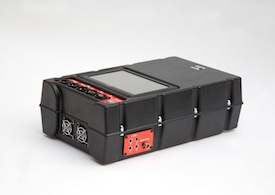
Blackmagic‘s Hyperdeck Shuttle is unashamedly targeted at a specific point on that continuum of size, weight and codec – it’s tiny and simple, and it records anything up to 10-bit 1080p30 YUV with no compression at all. The lack of compression means that it’s going to chew through storage at the really startling rate of around 120MB/sec for the highest end signals, give or take the audio. This provokes two further issues: sheer space, and speed, because something like the compactflash card you’d put in a Nanoflash can’t handle data at that rate regardless of how much actual storage space there is. Happily, the computer industry has provided us with an off-the-shelf solution in the form of the 2.5-inch solid state disk. This is a device both physically and electrically compatible with the 2.5-inch hard disks traditionally used in laptop computers, but flash-based so that the power consumption, weight and physical robustness are all much improved. The industry seems to have realized that these things are likely to be used as big, fast portable storage devices and usually supplies them fully-enclosed in a metal case, as opposed to hard disks which usually have exposed circuitry.
People will immediately worry about the sheer amount of information that this recorder is going to produce, and question whether it’s really practical at anything but the high end. I think it is, although it will require a properly thought-out postproduction and archiving workflow – not that you don’t need that with a Canon 5D, too, albeit for far less data. What’s really important is that all of these things will get a lot easier in time, as flash devices, hard disks and data tapes get bigger and cheaper. From a pure postproduction point of view, it’s hard to avoid the conclusion that any form of compression is bad news – not only does it sap picture quality, but many compression codecs are tied to particular manufacturers or pieces of software. Whether this is done deliberately to create vendor lock-in or not, uncompressed pictures are both more flexible and maximally future-proof, and will only get easier to handle in time.
There’s also the issue of purpose. The kinds of cameras on which this recorder is likely to be used may already use a flash recording system such as P2 or SD card, and there may be little practical purpose in replacing one heavily compressed recording option with another. Given the option to go uncompressed, though, any camera with a worthwhile HDMI or SDI output can be improved with this device.
Anyway, given their experience at building SDI and HDMI devices, the availability of suitable flash storage and the explosion in interest in this sort of thing, Blackmagic were clearly in a pretty good position to do this. The device itself is an almost minimalistic design, and it’s nice to realize that it really has been milled out of a solid block of metal. This is slightly surprising for a company that’s been known entirely for postproduction tools before, and it’s good to see they’ve immediately grasped the level of robustness required of a piece of camera equipment. There’s even a cheese plate accessory for it now with a variety of ¼-inch and 3/8-inch holes in it, for mounting to appropriate surfaces.
Of the six faces of the cuboid, three are entirely plain. One end is cut away to house the SSD, and the two long edges hold, respectively, the connectors and a rubberized control panel and indicator lights. Other than the two miniature coaxial connectors that provide video in and out, nothing protrudes, and it’s extremely difficult to hurt the thing. This creditable dedication to robustness doesn’t quite extend as far as the power connector, which is one of those miniature coaxial DC power connectors used on everything under the sun. There is no mechanical retention for the power cable, so it’s probably a good thing that the device has its own built in battery, good – according to the manufacturer – for about an hour’s work.

There are a couple of other design choices I’d argue with, but nothing terribly serious. The use of the little push-pull coax connectors for the SDI in and out is slightly questionable as you’d have thought there ought to be room for full-size ones, but then they do take up a lot of space behind the panel. Blackmagic supply two adapter cables, but astute users will procure spares, both to cover failures and because the supplied pair include one each of male and female BNCs which might not be quite what’s required. The only other gotcha is that it is, with extreme violence, possible to just shake the SSD out of the end of the recorder. The only retaining mechanism, as far as I can see, is the SATA connector, and that wasn’t really designed as a mechanical latch. It wouldn’t be an issue in normal use, but anyone subjecting one of these to a lot of vibration might want to wrap a piece of tape over the end to preclude this issue.
In use, the thing is incredibly simple – just plug the camera in, it will recognize the input format, and switch its output to the appropriate format for display. If you press “record,” it starts recording. If you press “stop,” it stops. But it does lack a few refinements that are on the studio version of the recorder – there’s no pause and frame forward or back, for instance, and I’ve raised that as a feature request because it’s often useful to frame through takes to examine things like reflections. Other than that it is so beautifully simple – which is a kind way of saying it actually has very few features – that it’s hard to get wrong. There is no way to delete takes from the card, which is a very good idea in a world of capricious directors who think they’re a lot more objective on set than they are. There is no remote start, unfortunately, and although various features are available over USB via control software that probably isn’t a solution for the studio floor.
The only major problem I have with this device is that it insists on using disks formatted in the HFS+ filesystem to record. Without going into intricate detail, a filesystem is a standard according to which data is arranged on a storage medium such as a flash card or hard disk, and they’re often associated with particular operating systems – Windows PCs generally use NTFS, whereas Macs use HFS+. There is an older standard, FAT32, that’s used on compactflash cards in digital stills cameras because there are no software licensing issues with it and it is compatible with more or less any computer currently working. The problem with FAT32 is that the maximum filesize is limited to around four gigabytes, which you’d reach in something like thirty seconds at 1080p24 10-bit YUV. Therefore, Blackmagic had to choose one of the more modern filesystems for the Shuttle recorder. Personally, I’d have much preferred to see NTFS used, as it can be read by practically all modern PCs, Macs and Linux machines. Presumably there are software licensing issues with NTFS, but this does mean that all Windows people who want to use this device will need to pay another $40 per computer for the MacDrive software to access the disks. Blackmagic are coy about why this decision was made, which is odd. Apple have licensed things like the ProRes codec to other recorder manufacturers and one might cautiously assume that Apple’s interest in vendor lock-in may lurk behind the decision. An unfortunate inconvenience. If the recorder offered DPX sequence recording, FAT32 could have been used since no one file would be more than a few megabytes, but that would also limit the maximum overall disk size to 2TB (which is presumably an imminent possibility given the pace of SSD development). As it is only Quicktime movies in the uncompressed V210 codec are available.
There may be interesting things in the future for the Hyperdeck Shuttle. There’s a button (marked “Disp”) on the side which is currently unassigned, and intended for future updates. Also, the very best SSDs are actually now fast enough to store 4:4:4 RGB video at rates over 50fps and this is only likely to improve with time. The SDI hardware in the Shuttle recorder is capable of 3Gbps operation and therefore could theoretically support 4:4:4 RGB modes and increased frame rates in 4:2:2 and 720p modes. Eventually the SATA link, which uses only the older 300Mbps specification, will become the limiting factor here, but it could in theory record almost anything that would fit down a single link of 3 Gig SDI.
At the end of the day, the big deal on this is that the Hyperdeck Shuttle only costs about $300. That’s very, very keen pricing, for something that could be used on all but the pickiest high-end productions, and it would be possible to put a kit together of three 128GB SSDs (17 minutes or so each at 1080p24 10-bit 4:2:2) and the recorder, plus cables, for considerably less than $1,000, including a very nice flight case. The old issue of what you then do with the data springs to the fore, which would imply an LTO4 drive and a suitable host system, and of course a person to run all this stuff. But by doubling up on SSDs and assuming you’d back up in the hotel overnight, it’s possible to put together a working, insurable, high-end data recording solution for… well, less than I suspect Sony are going to charge for one SR Memory card.
Thanks go to Johnny Johnson at the Gear Factory (http://www.gearfactory.co.uk/gf ) for supplying the Panasonic AF-101 for this review.
Source: http://www.btlnews.com